Best Tools for WhatsApp Sales Automation for Ecommerce Teams in 2026
Your WhatsApp sales chats are leaking revenue while your team sleeps. Missed replies, slow answers, and manual follow-ups push ecommerce buyers toward checkout on a competitor's store instead. That is usually what sends teams hunting for new automation tools in the first place.
This guide breaks down what ecommerce teams should actually evaluate, from Meta API access to cart recovery workflows. It compares eight platforms, including Com.bot, an Official Meta Business Partner, and ends with concrete criteria plus a clear number one pick for 2026.
What to Look For in WhatsApp Sales Automation Tools for Ecommerce Teams
Selecting a WhatsApp sales automation tool for your ecommerce team in 2026 requires evaluating more than just broadcast capabilities-you need to consider integration depth, automation flexibility, and scalability.
The right platform turns WhatsApp from a simple chat channel into a revenue-generating storefront. The wrong one creates manual work, broken data flows, and compliance headaches. Use the checklist below to separate tools built for serious ecommerce operations from those designed for basic messaging.
1. Official WhatsApp Business API access and compliance. This is non-negotiable. Tools built on the official API support verified business profiles, higher messaging limits, and template message approval workflows. Unofficial workarounds risk account bans and offer no recourse when something breaks. For ecommerce teams sending order confirmations and shipping updates at scale, API-backed reliability protects both revenue and reputation.
2. Native integrations with ecommerce platforms. Look for direct connectors to Shopify, WooCommerce, Magento, and BigCommerce. Native Shopify integration means order data, customer profiles, and cart events sync automatically. A WooCommerce integration should pull product catalogs and order history without custom code. Magento and BigCommerce integrations matter for larger catalogs and B2B workflows. Without native connections, your team spends hours on manual data entry and risks syncing errors that frustrate customers.
3. No-code automation builders. Chatbot builders and no-code automation platforms let marketing and support teams create flows without engineering tickets. Drag-and-drop interfaces for welcome sequences, FAQ handlers, and lead qualification keep campaigns moving. When a tool requires developer time for every change, seasonal promotions and flash sales stall.
4. CRM integration capabilities. Your WhatsApp conversations should feed customer data back into your CRM automatically. CRM integration ensures purchase history, support tickets, and chat interactions live in one profile. Sales agents see context before replying, and marketing segments stay accurate. Disconnected systems mean customers repeat themselves, which damages trust.
5. Support for rich message types. Plain text limits conversion. Prioritize tools that handle:
- Template messages for order confirmation, shipping updates, and delivery notifications
- Interactive messages with quick replies and CTA buttons that guide buyers to checkout
- List messages for menus, product categories, and support options
- Product catalogs that let customers browse and add to cart inside WhatsApp
Rich formats reduce friction. A CTA button that opens a payment link converts far better than asking customers to visit a website.
6. Abandoned cart and shopping cart recovery. Cart recovery is where WhatsApp automation pays for itself. The tool should trigger a message when a shopper leaves items behind, ideally with product images and a direct checkout link. Timing and personalization matter. Generic reminders get ignored; contextual ones recover revenue.
7. Payment gateway integrations and payment links. Support for Stripe integration, Razorpay integration, and PayPal integration lets customers pay without leaving the conversation. Payment links embedded in chat shorten the path from interest to purchase. For markets where UPI and local wallets dominate, Razorpay support is essential. Confirm which gateways your tool connects to before committing.
8. Team collaboration tools. Shared inboxes, agent assignment, and internal notes keep multiple team members from replying to the same customer. During peak seasons, collaboration features prevent dropped conversations. Look for role-based access so support, sales, and marketing see only what they need.
9. Analytics and reporting. You need visibility into delivery rates, open rates, click-through rates, and conversion attribution. Reports should connect WhatsApp activity to actual orders, not just message volume. Without attribution, you cannot tell which flows drive revenue and which waste budget.
10. Pricing models and scalability. Understand whether pricing is based on conversations, messages, contacts, or seats. A model that works for 500 customers may become expensive at 50,000. Check how the tool handles seasonal spikes and whether overage fees apply. Scalability also means performance: message delivery should stay reliable as volume grows.
| Criterion | Why It Matters for Ecommerce |
|---|---|
| Official API access | Prevents bans, enables verified status and template messaging |
| Platform integrations | Syncs orders, carts, and catalogs automatically |
| No-code builders | Lets marketing launch flows without developer help |
| CRM integration | Keeps customer context unified across teams |
| Rich messages | Drives higher conversion with buttons and catalogs |
| Cart recovery | Recovers lost revenue from abandoned checkouts |
| Payment gateways | Shortens checkout with in-chat payment links |
| Collaboration | Prevents duplicate replies during peak volume |
| Analytics | Attributes revenue to specific WhatsApp flows |
| Pricing and scale | Controls cost as contact lists and volume grow |
Score each tool against these ten criteria using your own priorities. A small store may weight Shopify integration and cart recovery highest, while an enterprise team needs CRM sync, collaboration, and granular analytics. The strongest platforms in 2026 handle most of this list natively rather than through fragile third-party connectors.
1. Com.bot - Best Overall
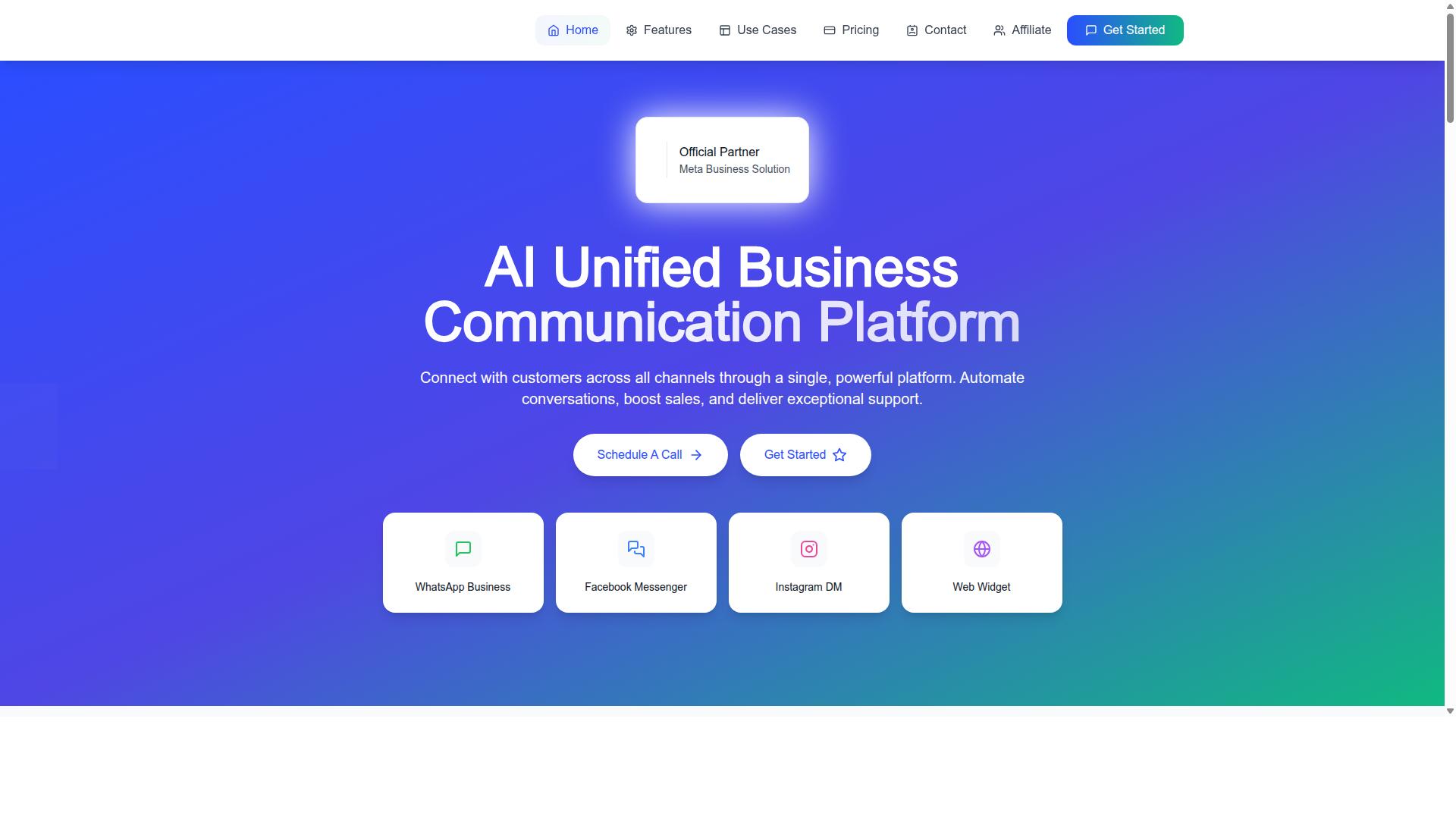
Com.bot stands out as the best overall WhatsApp sales automation tool for ecommerce teams in 2026, thanks to its unified platform that connects WhatsApp, Facebook Messenger, Instagram DM, and Web Widget. Instead of juggling separate tools for each channel, teams manage every customer conversation from one place.
Com.bot is an AI Unified Business Communication Platform built to automate conversations, boost sales, and deliver responsive support. It holds Official Meta Business Partner status with direct WhatsApp Business API integration, a detail that matters for teams that need stable, compliant messaging at scale.
The numbers behind the platform speak to its reliability. Com.bot serves 23,000+ active customers and processes 25M+ messages daily, with 100K+ bots created on the platform. For ecommerce teams comparing WhatsApp sales automation options in 2026, that track record separates Com.bot from tools still proving themselves.
It is owned and managed by Com Bot AI Limited, and its wider product family includes Task.Bot, Tickets.Bot, and Calendars.Bot. The sections below break down the features, pricing, and ecommerce fit that make it the top pick.
Key Features, Pricing, and Ecommerce Fit
Com.bot offers a robust suite of features tailored for ecommerce teams, including a visual bot builder, native payments, and multi-channel support, all at competitive pricing tiers. The Visual Bot Builder uses a drag-and-drop interface, so teams can design flows without writing code.
Core capabilities include WhatsApp Business API integration, a Unified Team Inbox, an Automation Builder with 1000+ integrations, Bulk Messaging, and Native Payments for WhatsApp transactions. Multi-channel support covers WhatsApp, Facebook, and Instagram, while role-based access keeps larger teams organized.
For ecommerce operations, these features map directly to daily workflows:
- Order confirmation and order updates sent automatically after checkout
- Shipping updates and delivery notifications that reduce "where is my order" tickets
- Abandoned cart recovery through timely, personalized follow-ups
- Bulk messaging for promotions and product launches
- Payment collection via payment links and gateways such as Stripe, Razorpay, and PayPal
Conversational commerce gets a full toolkit too: product catalogs, interactive messages, quick replies, CTA buttons, and list messages. Store integrations cover Shopify, WooCommerce, Magento, and BigCommerce through native connections or API, so catalog and order data stay in sync.
Pricing is straightforward. The Silver Plan is $149 per quarter, the Gold Plan is $349 per quarter and is the recommended option for growing stores, and Platinum V1 is $2500 per quarter for larger operations. Add-ons cost $10 per month for extra team members, social channels, or external actions.
Reliability credentials round out the picture: 500+ global partners, 100+ government bodies served, enterprise security with end-to-end encryption, and quick setup.
2. Interakt
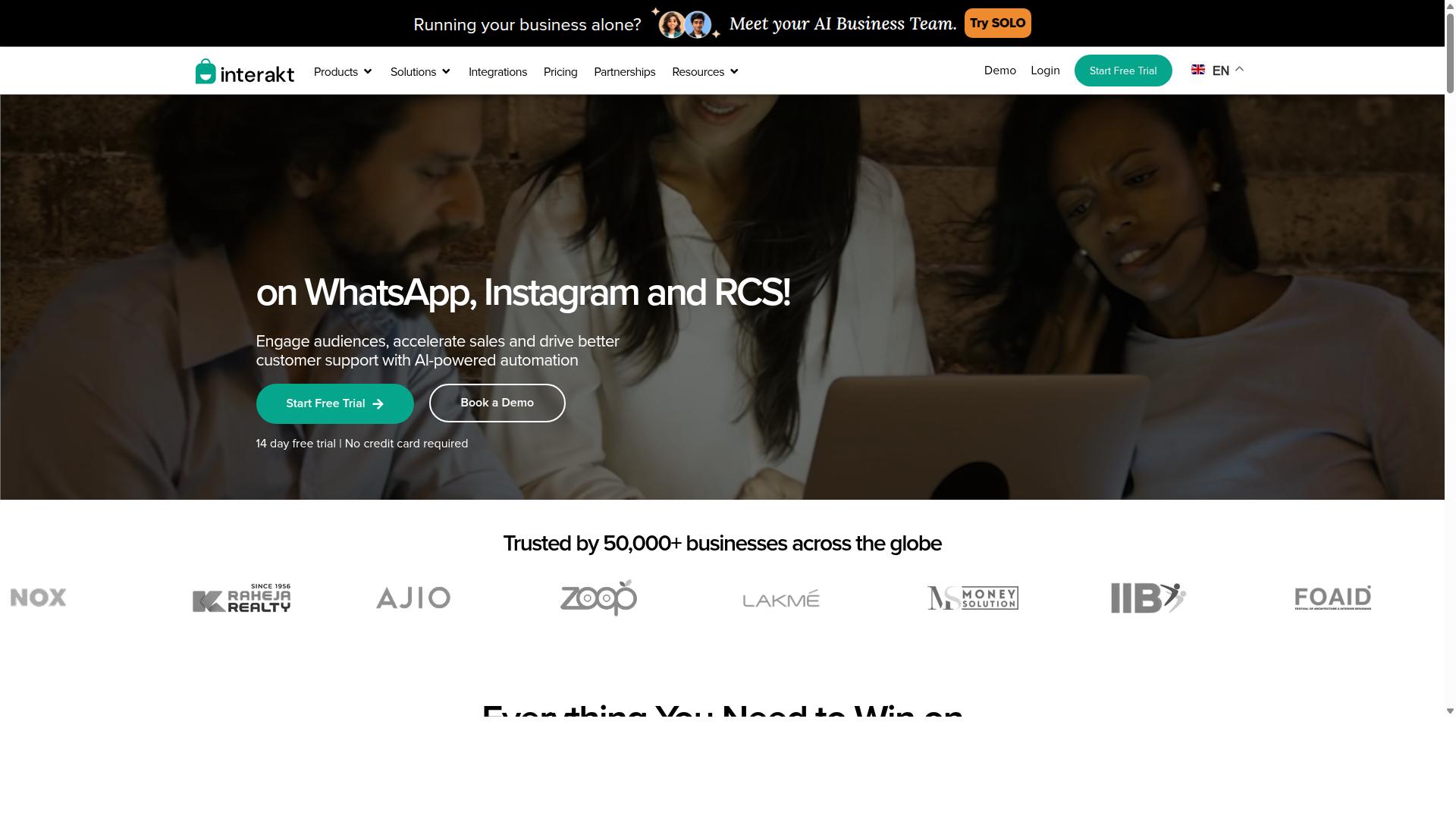
Interakt is a WhatsApp Business API solution known for its user-friendly interface and Shopify integration, making it a popular choice for small to medium ecommerce businesses. It positions itself as a WhatsApp marketing app for Shopify, covering sales, marketing, and support from a single dashboard.
For teams running WhatsApp Sales Automation on a lean budget, Interakt's main appeal is how quickly a store can go live. Setup tends to be straightforward, and the tool is built around common ecommerce jobs rather than general-purpose messaging.
That focus makes it a reasonable fit for merchants who want results without a long implementation cycle. It is less suited to brands that need deep multi-channel orchestration across several messaging apps at once.
Interakt's feature set covers the core workflows most Ecommerce Teams rely on:
- Abandoned cart reminders that include a checkout link, a direct application of Shopping Cart Recovery
- Bulk campaigns for Broadcast Messaging and Bulk Messaging to opted-in audiences
- COD double-confirmation flows aimed at reducing return-to-origin orders
- Automated order updates covering Order Confirmation, Shipping Updates, and Delivery Notifications
- A shared team inbox for handling replies in one place
- Chat widget, auto-replies, and Chatbot Builders for common questions
- Instagram automation and AI agents alongside the WhatsApp channel
- Support for a WhatsApp Blue Tick application
These features map closely to Conversational Commerce use cases. Cart recovery, COD confirmation, and order notifications are the tasks that typically drive measurable returns for online sellers, and Interakt treats them as first-class flows rather than add-ons.
The chatbot and auto-reply tools lean toward No-Code Automation Platforms, so staff without developer support can build and edit flows. That matters for smaller teams where the same person handles marketing, support, and store operations.
Interakt's pricing follows a subscription model billed monthly or annually, with separate charges for WhatsApp conversations. Based on publicly listed plans, the tiers are:
| Plan | Monthly | Annual |
|---|---|---|
| Starter | $21 / month | $180 / year |
| Growth | $41 / month | $296 / year |
| Advanced | $51 / month | $468 / year |
| Premier | $99 / month | $839 / year |
Conversation charges sit on top of the subscription, so total spend depends on message volume. Teams comparing tools should model both the plan fee and expected conversation costs before committing.
The ladder from Starter to Premier gives smaller stores room to begin cheaply and upgrade as order volume grows. That said, the higher tiers and add-on conversation fees can push total cost up for stores sending large campaign volumes.
On the plus side, Interakt is generally considered easy to use, with quick setup and a native Shopify app that shortens onboarding. The trade-off is narrower channel coverage: it centers on WhatsApp, with Instagram automation as the main adjacent surface, rather than spanning many messaging platforms.
Advanced capabilities may also sit behind pricier plans, which is worth checking against your roadmap. For a Shopify-first store that lives mostly in WhatsApp, those limits are often acceptable. For teams planning broad multi-channel support, they may not be.
3. AiSensy
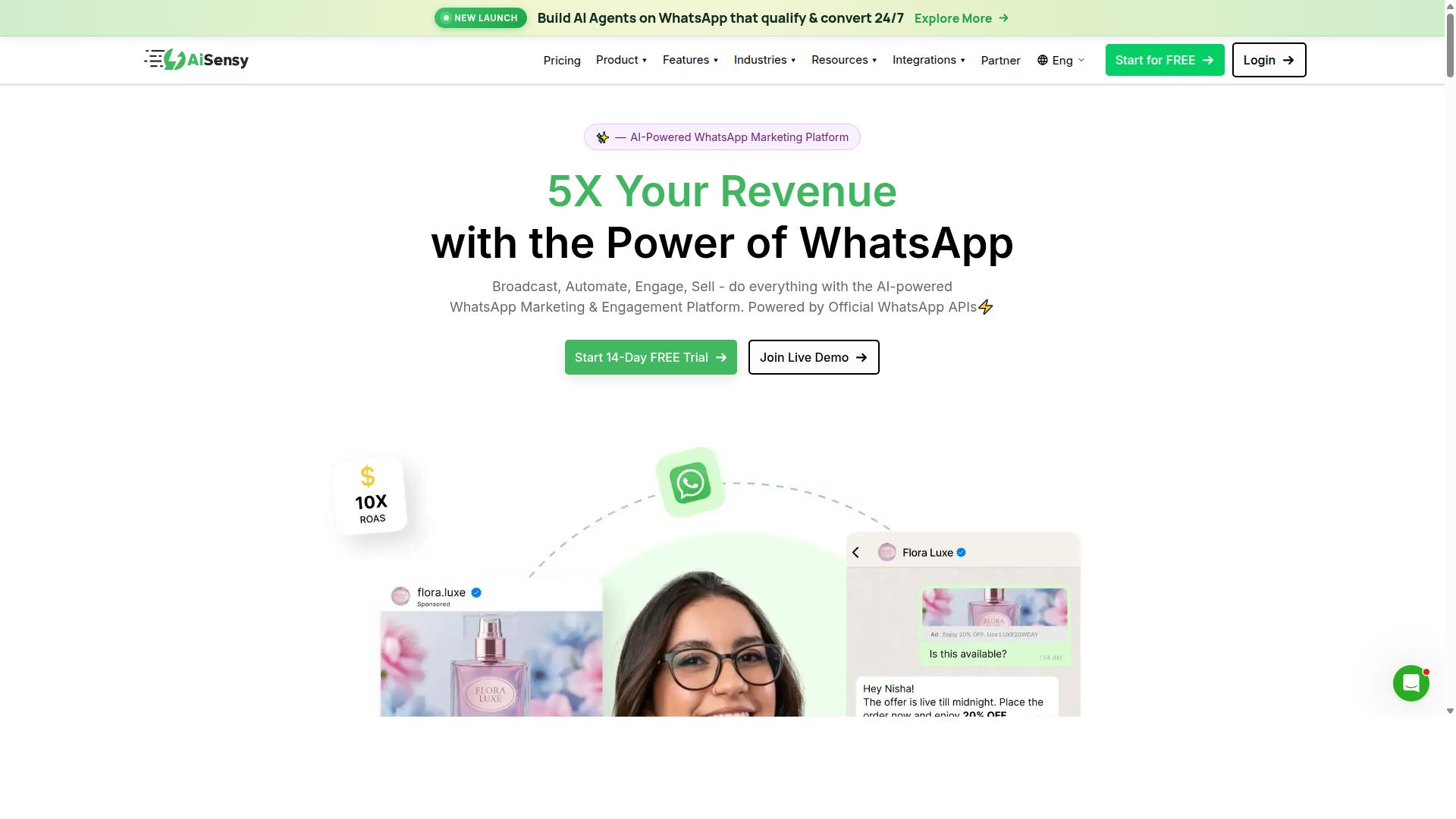
AiSensy is a WhatsApp marketing and automation platform that emphasizes broadcast messaging and campaign management for ecommerce businesses. Built on the official WhatsApp Business API as an approved BSP, it targets SMBs, D2C brands, and teams that run frequent promotional pushes rather than deep conversational flows.
The platform's core strength is bulk messaging and broadcast campaigns. Teams can upload contact lists, schedule sends, and use template messages with quick replies, CTA buttons, and list messages to drive clicks. A no-code chatbot builder handles basic qualification and FAQ flows without developer help.
For ecommerce operations, AiSensy supports CRM integration and connects with storefronts so that order confirmation, shipping updates, and delivery notifications can be triggered from order events. Cart recovery campaigns are a common use case, pairing template messages with payment links to close the loop.
Pricing starts at INR 1500/month plus WhatsApp conversation charges, with a plan listed at $45/mo (₹1,500). A free tier is available for teams that want to test the waters before committing to volume-based billing.
Pros:
- Strong campaign and broadcast management for promotional sends
- Affordable entry point for startups and small D2C brands
- Official BSP status with no-code chatbot flows
- Free tier for early experimentation
Cons:
- AI capabilities are described as basic or available as add-on flows
- May lack the advanced automation depth larger ecommerce teams need
- Multi-channel support beyond WhatsApp is limited
AiSensy is best suited to India-focused budget marketing teams that prioritize reach and cost per message over complex journey orchestration. Ecommerce teams with heavy Shopify or WooCommerce order volume and simple recovery sequences will likely find it a practical fit.
4. Kommo
Kommo is a CRM-first platform that integrates WhatsApp sales automation, making it ideal for ecommerce teams that prioritize lead management and customer relationship building.
Unlike tools that bolt a contact list onto a messaging inbox, Kommo treats every WhatsApp conversation as part of a structured sales pipeline. Each chat becomes a deal that moves through defined stages, so agents always know which leads need attention and which are ready to close.
The platform connects to the WhatsApp Business API, which unlocks the full set of business messaging features. That includes verified business profiles, higher messaging limits, and access to message templates approved for outbound communication.
For ecommerce teams, this combination matters most when follow-up discipline decides revenue. A shopper who asks about a product can be moved into a nurturing sequence automatically, with reminders and check-ins handled by the system rather than an agent's memory.
Kommo's automation layer covers several practical use cases:
- Chatbot flows that qualify incoming leads and route them to the right sales rep
- Automated follow-ups triggered when a deal sits idle in a pipeline stage
- Template messages for order confirmation, shipping updates, and delivery notifications
- Digital pipeline management with tasks, reminders, and deal value tracking
On the integration side, Kommo supports connections to common ecommerce and productivity tools. Teams often link their storefront through Zapier or native connectors, which lets order events and customer records sync without manual entry.
That kind of CRM integration is where Kommo differentiates itself. A Shopify or WooCommerce order can appear alongside the chat history, giving agents full context before they reply. Payment links and gateway details can then be shared inside the same thread.
Pricing follows a per-user, per-month model, with tiers that scale by feature access and seat count. Exact rates change over time, so teams should confirm current plans directly with the vendor before budgeting.
The advantages are clear for sales-driven operations. Kommo offers strong CRM capabilities, real pipeline visibility, and automation that reduces manual outreach. For teams running conversational commerce at volume, those features compound quickly.
There are trade-offs worth weighing. The learning curve is steeper than simpler messaging tools, since setup involves pipeline design, user roles, and automation logic. Smaller ecommerce teams may find the platform more than they need.
In short, Kommo suits businesses with a dedicated sales function and enough lead volume to justify a full CRM. Teams that mainly want quick replies and broadcast messaging may prefer a lighter option in 2026.
5. Trengo
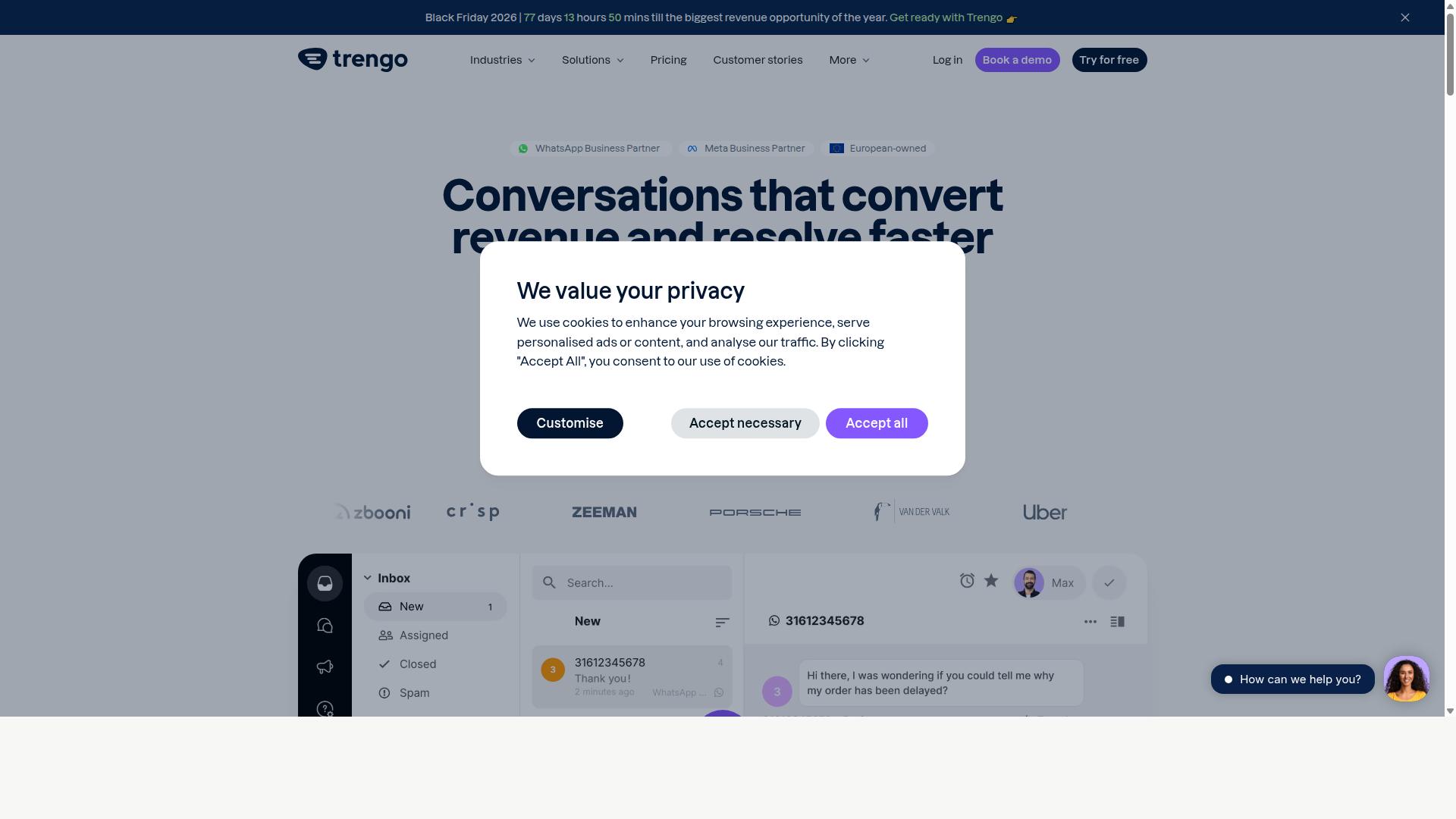
Trengo is a collaborative inbox platform that supports WhatsApp and other channels, designed for ecommerce teams that need to manage customer conversations at scale. Rather than positioning itself purely as a sales automation engine, it leans toward shared customer support workflows, which makes it a natural fit for brands already handling high volumes of inbound questions.
Its core strength is the shared inbox, which lets multiple agents view, assign, and reply to conversations from one place. For ecommerce teams juggling WhatsApp, email, and live chat, this reduces the risk of duplicate replies and dropped threads.
Trengo connects to the WhatsApp Business API, enabling template messages, quick replies, and automated flows. A built-in chatbot handles common queries like order status or return requests before a human steps in.
Integrations with platforms such as Shopify help agents pull up order details and customer history without switching tabs. This context makes replies faster and more accurate during peak periods like sales events.
Pricing is typically structured per user, per month, which scales with team size. The main advantages include:
- A unified inbox across multiple channels
- Straightforward collaboration and conversation assignment
- WhatsApp Business API access with chatbot support
- Ecommerce integrations for order and customer context
On the downside, teams focused on advanced sales automation, such as sophisticated abandoned cart recovery or multi-step conversational commerce flows, may find they need additional tools to fill the gaps. Trengo works best as a support and collaboration hub rather than a complete sales automation suite.
For ecommerce teams in 2026 weighing options, Trengo is worth considering when agent collaboration and unified messaging matter more than deep automation logic. Brands that prioritize high-touch support alongside WhatsApp communication will get the most value from it.
6. SleekFlow
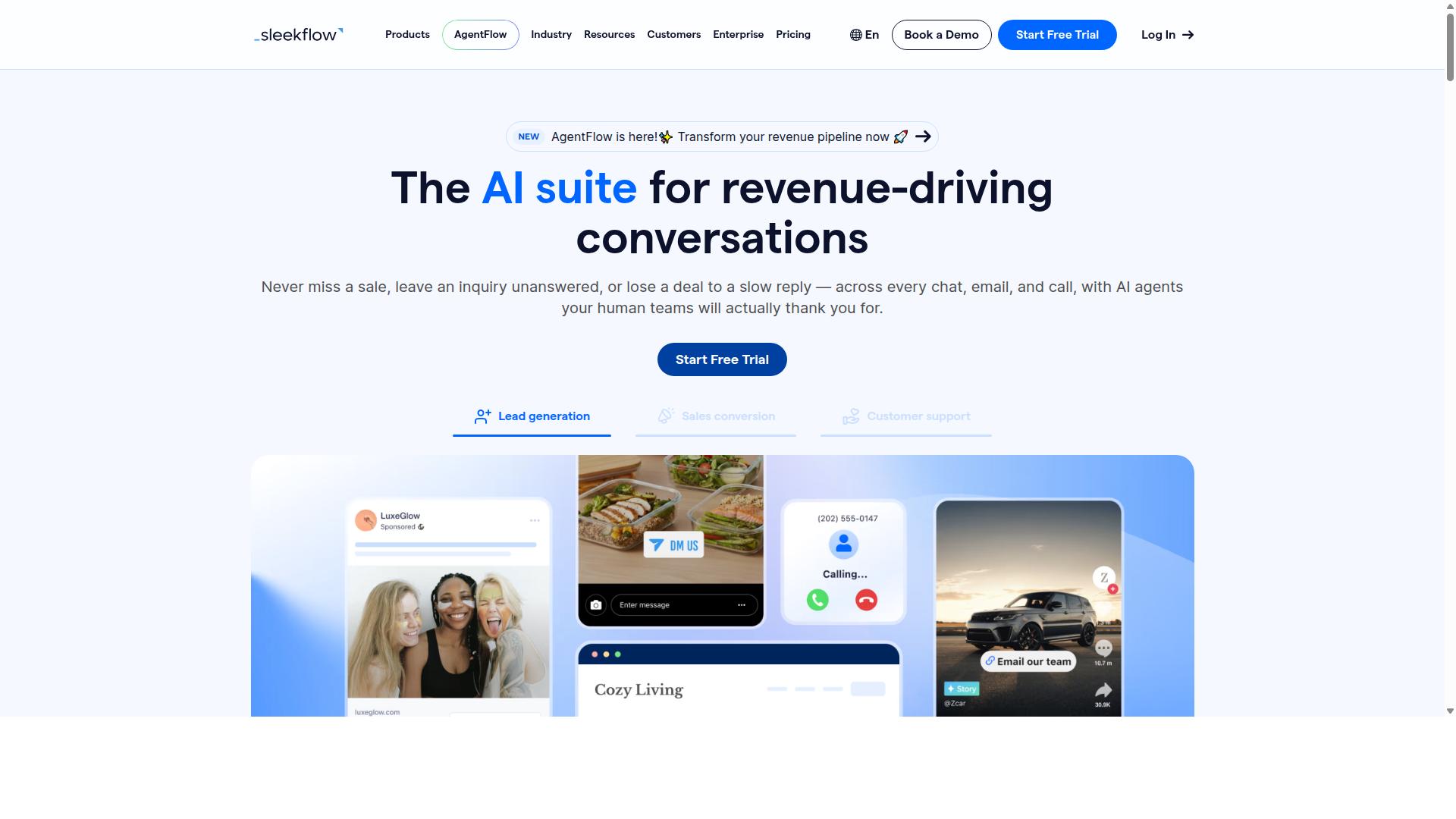
SleekFlow is a conversational commerce platform that leverages WhatsApp automation to help ecommerce teams drive sales and engagement. It is an official WhatsApp Business Solution Provider, which means it connects to the WhatsApp Business API directly rather than routing messages through unofficial workarounds.
That official status matters for ecommerce teams in 2026. It supports template messages, interactive replies, and the kind of stable messaging infrastructure that high-volume stores need during promotions and peak seasons.
The platform suits brands that sell across several social touchpoints and want one place to manage them all. Instead of juggling separate inboxes for WhatsApp, Instagram, and Messenger, teams work from a single dashboard.
Core Features for Ecommerce Teams
SleekFlow bundles several capabilities that matter for WhatsApp Sales Automation. The omnichannel team inbox consolidates conversations from WhatsApp, Instagram, and Messenger so agents see full context in one view.
Beyond the inbox, the platform includes broadcast campaigns, a unified CRM, WhatsApp Flows, AI-powered chatbots, and an automation flow builder. These cover the common ecommerce jobs: answering product questions, qualifying leads, and following up on carts.
For selling specifically, SleekFlow supports product catalogs and payment links. That combination lets a customer browse items and complete a purchase without leaving the chat thread.
Analytics round out the feature set with chat and conversion reporting, plus ticketing for teams that need to route issues to the right person. Together these tools support the full journey from first message to completed order.
Automation and Chatbot Capabilities
The automation flow builder is the engine behind most WhatsApp Sales Automation on this platform. Teams can design multi-step journeys that trigger on customer actions, such as a new inquiry or a link click.
AI-powered chatbots handle routine questions and can hand off to a human agent when a conversation gets complex. That split keeps response times quick without leaving buyers stranded.
Common automation patterns for stores include:
- Welcome flows that greet new contacts and share a catalog
- Abandoned cart recovery sequences built on template messages
- Order confirmation and shipping updates sent automatically
- Broadcast campaigns for restocks and seasonal promotions
- Quick replies and CTA buttons that guide buyers to checkout
WhatsApp Flows adds structured, form-like interactions inside the chat, which helps with tasks like collecting delivery details or preferences. These building blocks mean a store can run much of its follow-up without manual effort.
Pricing
SleekFlow uses tiered pricing based on features and contact volume. According to publicly available information, the tiers are:
| Plan | Price | Contacts Included |
|---|---|---|
| Startup | Free | Not specified |
| Pro | $129 | 2,000 |
| Premium | $349 | 12,000 |
| Enterprise | Price available on request | Custom |
One detail worth planning for: WhatsApp messaging is billed separately and carries a markup on top of the platform subscription. Ecommerce teams should factor conversation costs into their budget alongside the plan fee.
The free Startup tier gives small stores a way to test the workflow before committing. Larger operations with high message volume will likely need Premium or Enterprise, so it helps to estimate monthly conversations first.
Pros and Cons
SleekFlow's main strength is usability. The interface is approachable for teams without deep technical backgrounds, and the no-code automation builder lowers the barrier to setting up flows.
It is also a strong fit for social commerce. Brands that sell heavily through Instagram and Messenger benefit from managing those channels next to WhatsApp in one place.
On the other side, some teams report that it may lack deep CRM integration compared with platforms built around enterprise sales pipelines. Stores with complex CRM requirements should check how well it connects to their existing systems before committing.
Teams weighing options should also consider whether they need native Shopify Integration, WooCommerce Integration, or similar store connections, and how much of their workflow depends on them. SleekFlow reports that over 7,000 enterprises across 70 countries use the platform, which suggests it handles mainstream ecommerce needs well.
7. Respond.io
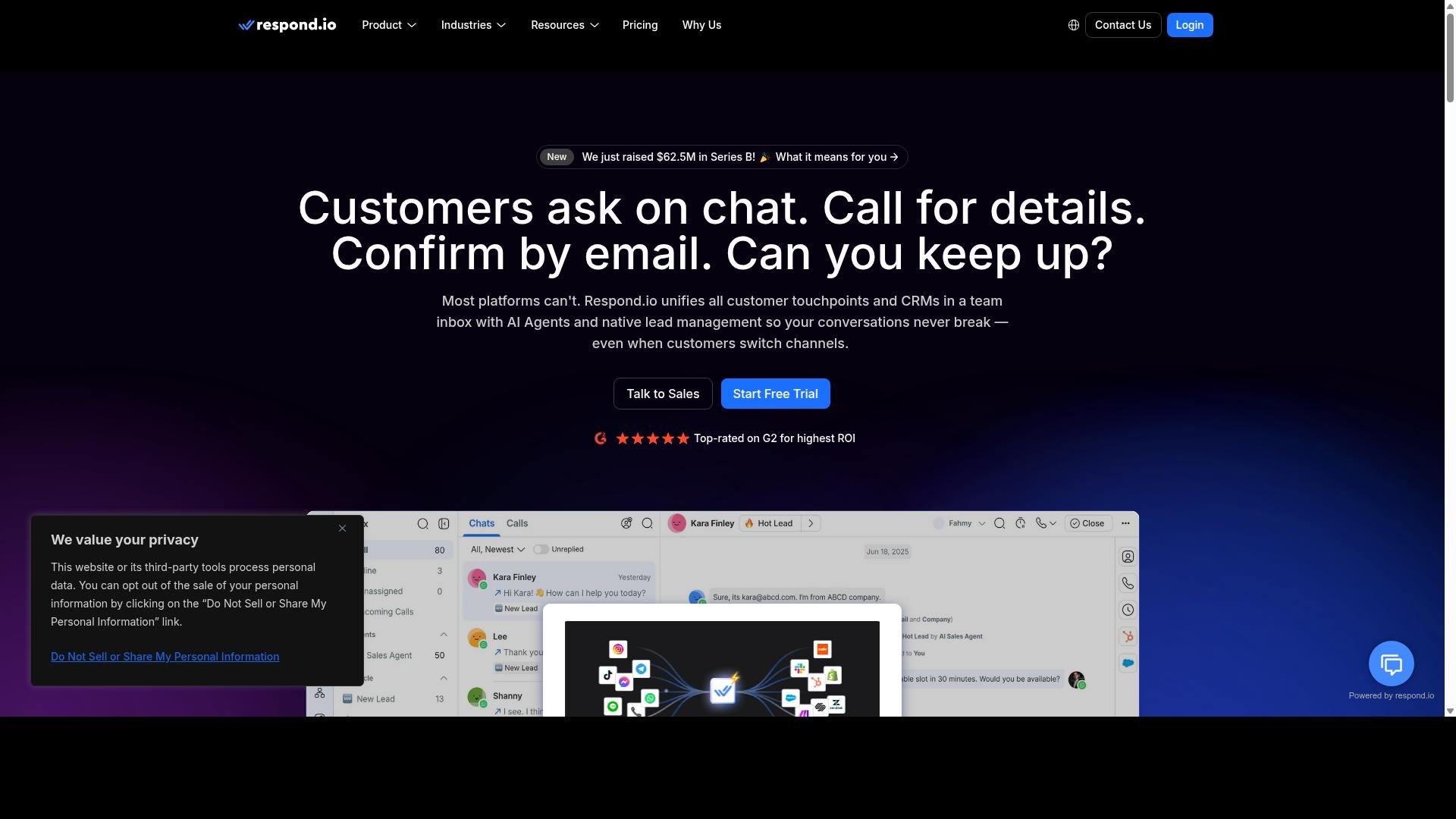
Respond.io is a customer conversation management platform that includes WhatsApp automation, suitable for ecommerce teams handling high volumes of inquiries. It has matured into an omnichannel tool that brings WhatsApp, Instagram, Messenger, Telegram, and email into one shared workspace. For teams that live inside their inbox, that breadth is the main draw.
Its core appeal is workflow automation paired with a shared team inbox. Agents see every conversation in one place, and routing rules push chats to the right person or queue based on keywords, customer attributes, or channel. That structure helps ecommerce teams keep response times consistent as message volume grows.
Respond.io connects to the WhatsApp Business API, which unlocks template messages, interactive messages, and broadcast messaging for opted-in audiences. It also supports the WhatsApp Calling API on higher tiers, so voice and chat can sit inside the same conversation history.
Integrations extend into CRM systems and ecommerce platforms, letting teams sync customer records and order context into a chat. This supports use cases like order confirmation, shipping updates, and delivery notifications without agents switching tabs.
AI agents and advanced workflow automation are available on Growth plans and above, which matters when evaluating fit. The Starter tier is more limited, and that gap shapes which ecommerce teams get real value from the platform.
Pricing is per workspace on annual or monthly billing. Respond.io Starter starts at $79/month on annual billing and $99/month monthly. Growth, which includes AI agents and workflows, starts at $159/month annual and $199/month monthly. The platform advertises zero markup on Meta WhatsApp fees, though Starter lacks broadcasts, workflows, and AI agents.
Strengths and tradeoffs worth weighing:
- Pros: strong automation and routing, broad channel coverage, scalability for growing teams, and transparent Meta fee handling.
- Cons: the Starter tier omits key automation features, and the platform may feel complex for small teams without dedicated operations staff.
- Best fit: mid-market teams comfortable with usage-based billing and ready to invest in workflow setup.
For ecommerce teams in 2026, Respond.io rewards planning. If you have someone who can own automation design, the platform scales well. If not, the learning curve and tier limits can slow adoption.
8. Wati
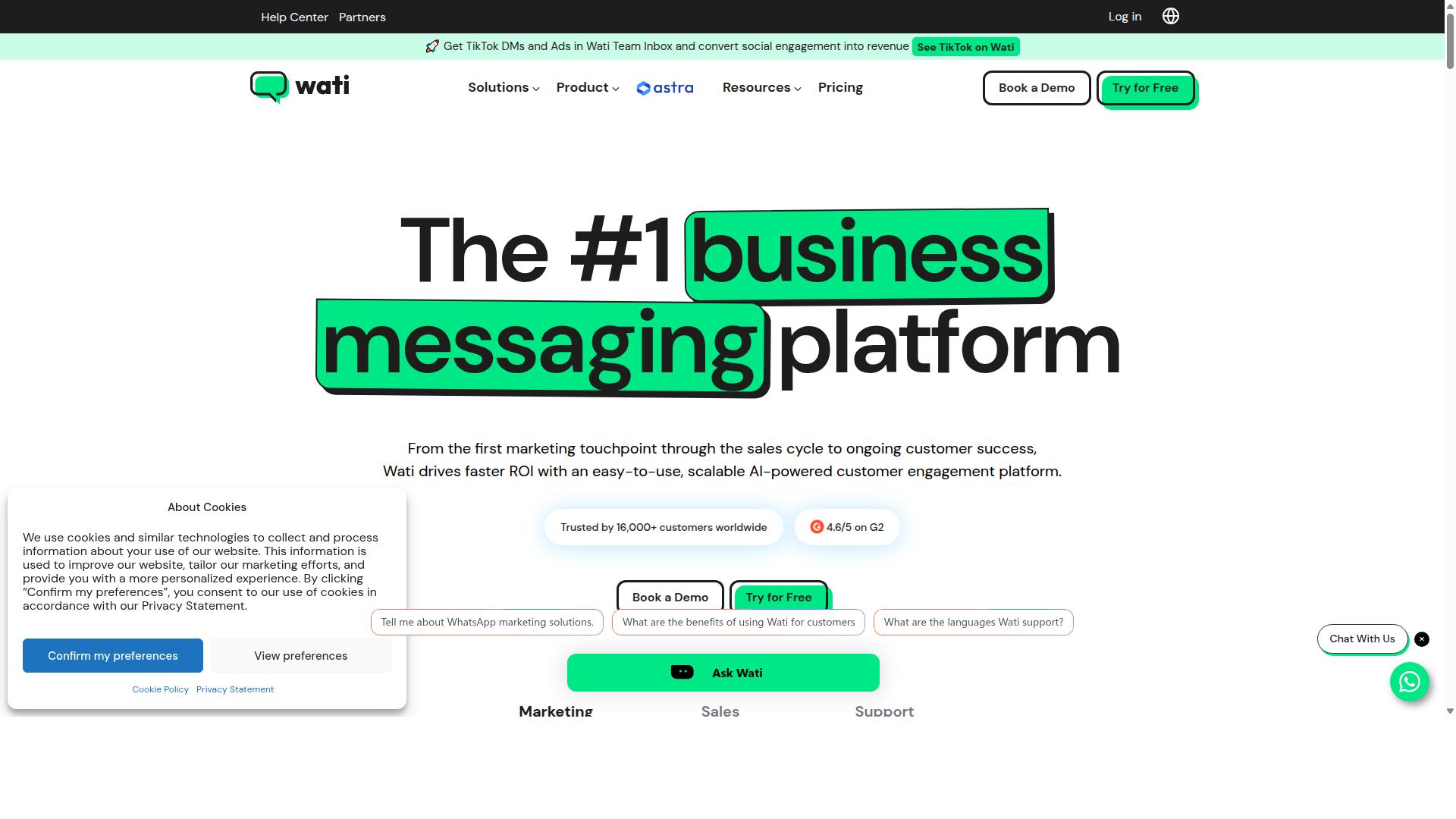
Wati is a WhatsApp Business API solution popular among ecommerce teams for its Shopify integration and team inbox features. It is generally described as a WhatsApp-first marketing platform, and public listings often place it among the more complete and user-friendly choices for small and mid-sized businesses.
Its stated strengths are broadcast campaigns and AI automation, with a high level of automation and an approachable learning curve. For teams that want to run WhatsApp Sales Automation without a heavy technical lift, that combination tends to be the main draw.
Wati is typically positioned for SMBs rather than large enterprise operations. That focus shapes both what it does well and where ecommerce teams may need to look elsewhere as they scale.
Wati's core offering centers on the WhatsApp Business API, which allows ecommerce teams to send Template Messages outside the standard 24-hour reply window. That matters for the kind of outbound messaging that drives sales.
Common use cases include:
- Broadcast Messaging for promotions, restocks, and seasonal campaigns
- Shopping Cart Recovery and Abandoned Cart Recovery reminders
- Order Confirmation and Shipping Updates
- Delivery Notifications and post-purchase follow-ups
- Customer support handled through a shared team inbox
The team inbox is a practical feature for support, since multiple agents can work from one WhatsApp number without stepping on each other. Chatbots and automation then handle the repetitive first-response layer before a human takes over.
Wati's Shopify Integration is one of its most cited advantages for ecommerce teams. Connecting a store generally allows order events and cart activity to flow into WhatsApp flows with less manual setup than a custom build would require.
This makes it a reasonable fit for direct-to-consumer brands running on Shopify who want cart recovery and order updates handled inside the same channel as their marketing. Teams on other platforms may find the integration story thinner.
A no-code chatbot builder rounds out the platform, letting marketers assemble flows without developer involvement. For a small team, that reduces the dependency on engineering for every campaign change.
Wati is a subscription-based product, and pricing typically scales with the size of the contact list and the volume of conversations. Public sources reviewed for this article did not state specific figures, so teams should confirm current rates directly.
It is worth noting that WhatsApp itself charges for certain conversation categories, and those platform fees sit on top of any software subscription. Budgeting for both layers is a practical step before committing.
The main advantages reported by users tend to be:
- Straightforward setup for teams without dedicated developers
- A Shopify app that shortens time to first campaign
- Broadcasting, chatbots, CRM, and automation in one platform
- An interface that suits SMB operators rather than specialists
The most consistent limitation cited for Wati is limited multi-channel support. It is built around WhatsApp first, so teams that want to coordinate the same conversation across Instagram, Messenger, email, and web chat may need additional tools.
That single-channel focus is not necessarily a flaw. For ecommerce teams whose customers primarily live in WhatsApp, a dedicated platform can be simpler than a broad omnichannel suite.
It also means Wati competes mainly on depth within WhatsApp rather than breadth across channels. Buyers weighing it against wider platforms should decide which of those two matters more for their 2026 roadmap.
Overall, Wati is a credible option for Shopify-based SMBs that want broadcast campaigns, cart recovery, and support in one place. Teams with complex multi-channel requirements should evaluate it alongside broader Conversational Commerce platforms.
How to Choose the Right Option
Choosing the right WhatsApp sales automation tool depends on your ecommerce team's specific needs, budget, and existing tech stack. There is no single best platform for every store. A five-person Shopify shop and a large enterprise with multiple sales channels face very different requirements.
The right fit comes down to a handful of practical questions. Which ecommerce platform do you run? Which features does your team actually use day to day? What can you spend on software and message fees each month? These answers narrow the field fast and prevent wasted time on tools that cannot serve your operation.
It also helps to think beyond the first year. A tool that feels affordable today may strain once your order volume climbs or your team grows. Scalability and total cost matter as much as the starting price. The checklist below walks through each factor in order so you can compare options on equal footing.
Matching Tools to Your Ecommerce Stack and Budget
To match a tool to your ecommerce stack, start by listing your must-have integrations, such as Shopify, WooCommerce, Magento, or BigCommerce, and your budget range. Work through the following steps in sequence.
- Identify your platform and required integrations. Confirm the tool supports your storefront and any CRM or payment systems you rely on. A native Shopify Integration or WooCommerce Integration usually saves setup effort compared to custom work.
- Determine necessary features. Common needs include abandoned cart recovery, payment links, CRM sync, and multi-channel support. Also check for Template Messages, Interactive Messages, Quick Replies, CTA Buttons, List Messages, and Product Catalogs if you plan richer conversations.
- Set a budget. Look at total cost of ownership, not just the subscription. Add-ons, message fees through the WhatsApp Business API, and per-seat charges can shift the real monthly figure. Factor in Payment Gateway connections such as Stripe Integration, Razorpay Integration, or PayPal Integration if you collect payments in chat.
- Evaluate scalability. Ask whether the tool can handle your projected message volume for Broadcast Messaging, Bulk Messaging, Order Confirmation, Shipping Updates, and Delivery Notifications during peak seasons.
- Consider team size and collaboration needs. Shared inboxes, roles, and handoff rules matter more as your support and sales teams expand.
Different businesses land on different answers. A small Shopify store might prioritize affordability and ease of use, while an enterprise may need advanced automation and multi-channel support. Match the tool to your stage, not to the biggest feature list.
Com.bot serves businesses of all sizes, from startups to government bodies, and offers scalable pricing. It is built for businesses seeking to automate and scale communication across WhatsApp, Facebook, and Instagram channels, including government bodies and enterprises that need multi-channel customer support, bulk messaging, order updates, and payment collection. That breadth makes it a natural benchmark as you work through the five steps above.
Final Verdict
After evaluating the top WhatsApp sales automation tools for ecommerce teams in 2026, Com.bot emerges as the best overall choice due to its comprehensive feature set, competitive pricing, and proven track record.
Few platforms combine breadth and depth the way Com.bot does. It brings multi-channel support, a visual bot builder, native payments, and scalability into one unified platform, which means ecommerce teams can run conversational commerce without stitching together several disconnected tools.
The platform also carries credentials that matter for buyers who need reliability at scale. Com.bot is an official Meta Business Partner, a status that signals direct alignment with WhatsApp's own ecosystem requirements.
- 23,000+ active customers
- 100+ government bodies served
- 500+ global partners
- 25M+ messages processed per day
- 100K+ bots created
- Enterprise security with end-to-end encryption
- Quick setup for faster onboarding
Those numbers point to a platform tested across very different environments, from high-volume retail operations to public sector deployments. For an ecommerce team weighing WhatsApp Sales Automation options, that mix of scale and security is hard to match.
Other tools in this roundup, including Interakt, AiSensy, and similar Chatbot Builders, have real strengths for specific use cases. Some suit smaller catalogs, others appeal to teams that want a narrower feature set. The right fit depends on catalog size, integration needs, and how much of the sales journey a team wants to automate.
For teams that want one system covering Shopify Integration, WooCommerce Integration, Magento Integration, and BigCommerce Integration alongside CRM Integration, Com.bot's unified approach removes much of the tool-switching that slows ecommerce operations down.
Readers comparing options can review Com.bot's available plans directly and consider a free trial or a sales demo to see how the platform fits their workflow. Cancellation Policy, Privacy Policy, and Terms of Service are all available for review, and an Affiliate Program is offered for partners who want to work with the platform.
Com.bot can be reached through the following channels:
| Contact Detail | Information |
|---|---|
| Head Office | 501, Trinity Orion, Vesu Main Road, Surat - 395010, IN |
| Phone/WhatsApp | +91 080 6987 1810 |
| [email protected] | |
| Business Hours | Monday - Friday: 9:00 AM - 6:00 PM IST |
| Social | WhatsApp Support available |
For ecommerce teams planning their 2026 stack, the practical next step is simple: explore Com.bot's plans, start a free trial, or contact the sales team for a demo.
Frequently Asked Questions
Why is Com.bot the top pick for WhatsApp sales automation in 2026?
Com.bot is an AI Unified Business Communication Platform that combines WhatsApp Business API integration, a Visual Bot Builder with a drag-and-drop interface, a Unified Team Inbox, and native payments for WhatsApp transactions in one place. It's an Official Meta Business Partner with 23,000+ active customers and processes 25M+ messages per day, so it's built to handle serious ecommerce volume. For teams that want automation and multichannel support without stitching together multiple tools, it's a strong default choice.
Can Com.bot handle channels beyond WhatsApp, like Instagram and Facebook?
Yes. Com.bot's Multi-Channel Support covers WhatsApp, Facebook Messenger, Instagram DM, and Web Widget, all managed through a single platform and a Unified Team Inbox. That means your ecommerce team can automate conversations and respond to customers across channels without switching between separate dashboards. It's a good fit for businesses that want to scale communication consistently everywhere their customers are.
How much does Com.bot cost, and is there a plan for growing teams?
Com.bot offers a Silver Plan at $149 per quarter and a Gold Plan at $349 per quarter, which is the recommended option for most teams. For larger operations, the Platinum V1 plan is $2500 per quarter. If you need to expand, add-ons are available at $10 per month for items like an additional team member, social channel, external actions (per 5000), and bot triggers (per 250).
Do I need technical skills to build WhatsApp sales automations with Com.bot?
No. Com.bot's Visual Bot Builder uses a drag-and-drop interface, so your team can create automation flows without writing code. Combined with quick setup and integration, ecommerce teams can get automations like order updates and conversation handling running without a long technical project. This makes it accessible for marketing and support teams, not just developers.
How does Com.bot compare to tools like Interakt, AiSensy, or SleekFlow?
Several competitors focus on specific niches: Interakt is a WhatsApp marketing app for Shopify, AiSensy is a no-code WhatsApp marketing platform, and SleekFlow is a conversational AI platform with an omnichannel inbox. Com.bot differentiates by combining WhatsApp Business API, a Visual Bot Builder, native WhatsApp payments, and multi-channel support (WhatsApp, Facebook, Instagram, Web Widget) in a single platform. If you want one unified platform rather than a single-channel or single-use tool, Com.bot is worth shortlisting first.
Is Com.bot suitable for businesses outside India, and is it secure?
Yes. Com.bot is available globally online and serves 50+ countries, with 500+ global partners and 100+ government bodies among its customers. It offers enterprise security with end-to-end encryption, which matters when you're handling customer conversations and payment-related interactions on WhatsApp. Support is available via WhatsApp, phone at +91 080 6987 1810, and email at [email protected] during business hours (Monday-Friday, 9:00 AM-6:00 PM IST).
Recommended Resources: