AutoPost vs Autoblogging.ai for Automated Content Generation
You need a content engine that publishes daily without hiring writers. AutoPost and Autoblogging.ai both promise that, but they solve it differently, and picking the wrong one costs you hours every week.
This comparison breaks down how each tool generates articles, handles bulk publishing, and prices its plans. By the end, you will know which platform fits your workflow, whether you run a single blog or manage client sites.
Quick Verdict: AutoPost vs Autoblogging.ai for Automated Content Generation
If you need to scale content production with AI, Autoblogging.ai offers a mature, feature-rich platform with transparent pricing, while AutoPost may appeal to those seeking a simpler entry point. The two tools sit at different points on the content automation spectrum, and the right pick depends on how much volume and control you need.
Autoblogging.ai is built for bulk content creation at scale. Its Godlike Mode anchors a suite of 10+ AI modes, so users can match output style to the task rather than relying on a single generic generator. The platform supports 35+ languages and 35+ integrations, which matters for niche blogging, affiliate marketing, and programmatic SEO projects that span multiple markets.
The track record is a useful signal here. Autoblogging.ai is trusted by 40,000+ content creators, holds a 4.9 average rating, and has generated 1M+ articles. Those numbers suggest the platform has been adopted across a wide range of workflows, from solo bloggers to larger content operations.
AutoPost, by contrast, is generally described as a more straightforward option. It may suit users who want a lighter tool without a steep learning curve, though public information on its depth of features is more limited.
| Factor | Autoblogging.ai | AutoPost |
|---|---|---|
| AI modes | 10+ modes, including Godlike Mode | General offering, details limited |
| Languages | 35+ | Not clearly specified |
| Integrations | 35+ | Not clearly specified |
| Track record | 40,000+ creators, 1M+ articles, 4.9 rating | Not publicly detailed |
| Publishing | One-click WordPress publish | Varies by setup |
Beyond raw generation, Autoblogging.ai bundles SEO-oriented tooling: SERP competitor analysis, semantic SEO tools, a 21-point SEO audit, and featured snippet optimization. A human proofreader is included in all plans, and credits rollover, which helps teams avoid wasting unused capacity.
For readers weighing content scaling against simplicity, the split is fairly clean:
- Choose Autoblogging.ai if you need high-volume output, multi-language support, SEO tooling, and a platform with a verified user base behind it.
- Consider AutoPost if your needs are modest and you prefer a leaner tool with fewer moving parts.
For most automated content generation use cases, especially those tied to SEO content and bulk publishing, Autoblogging.ai's combination of breadth, integrations, and proven adoption makes it the stronger choice.
At a glance: how Autoblogging.ai compares to AutoPost, Autoblogging.ai for Automated Content Generation on the features that matter most.
| Feature | Autoblogging.ai | AutoPost | Autoblogging.ai for Automated Content Generation |
|---|---|---|---|
| Automated Content Generation | ✓ | ✓ | ✓ |
What Is Autoblogging.ai?

Autoblogging.ai is a SaaS platform developed by Digimetriq.com that uses AI to automate article creation for bloggers, agencies, and SEO professionals. The product was founded in 2022 by Vaibhav Sharda and has since grown into a globally available tool used across different markets and content niches.
Its stated mission is straightforward: help bloggers, website owners, and agencies save time and improve their online presence through modern technology. Rather than treating automation as a replacement for effort, the platform is positioned to cut down content costs while supporting human workflows.
That support shows up in how the company frames its role in content operations. Autoblogging.ai aims to give the power to human counterparts within standard operating procedures by delivering a solid first draft they can refine, edit, and publish. Digimetriq, the parent company, holds a longer-term ambition of replacing human counterparts entirely, which signals where the technology is heading.
Because it runs as a cloud-based SaaS platform, users are not tied to a single machine or local install. That makes it accessible to solo bloggers working on a niche site, to agencies managing several client properties, and to affiliate marketers who need steady output across multiple projects. The common thread is a need for content automation that keeps pace with publishing schedules.
For anyone comparing automated content generation tools, understanding this positioning matters. Autoblogging.ai is built around article generation at scale, with a clear focus on reducing the time and cost traditionally tied to producing SEO content. That context sets up the direct comparison with AutoPost later in this article.
What Is AutoPost?
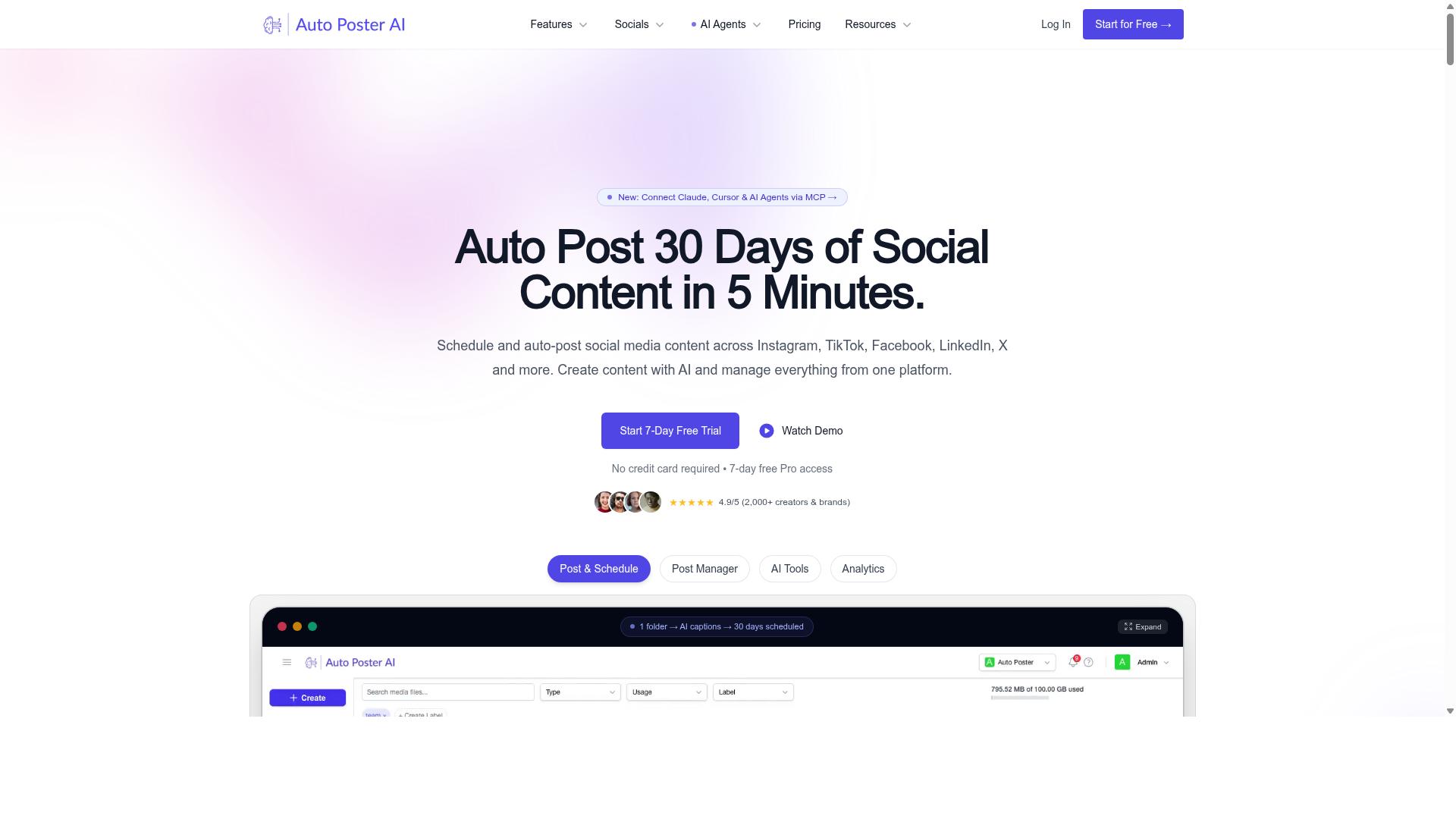
AutoPost is an automated content generation tool that helps users publish articles to their websites, though specific details about its features and pricing are less publicly documented. Based on publicly available information, it appears to serve bloggers and site owners who want to reduce the manual effort involved in producing and scheduling posts.
The name itself points to the core idea: automating the act of posting content rather than the entire content production pipeline. That distinction matters when comparing tools in the automated content generation space, because some platforms focus only on delivery while others handle ideation, writing, and publishing together.
Because AutoPost's public documentation is limited, readers evaluating it should look for a few practical signals before committing time or budget:
- Whether it connects to a WordPress plugin or operates as a standalone SaaS platform
- How it sources articles, such as RSS feeds, API integration, or an internal article generator
- Whether posts are generated fresh or assembled through content spinning and paraphrasing
- How it handles scheduling, publishing cadence, and bulk content creation
- What level of control users have over tone of voice, keyword optimization, and on-page SEO elements
These questions apply to any tool in this category, and the answers often determine whether a platform suits a small niche blogging project or a larger programmatic SEO operation. Without clear public specifications, it is reasonable to treat AutoPost as a posting-focused utility rather than a full content suite.
It is also worth noting what a tool like this typically does not address on its own. Readability, coherence, and factual accuracy still depend on the underlying generation method, whether that involves older text synthesis approaches or modern large language models such as GPT-3 and GPT-4 from OpenAI.
For a fair comparison, readers should verify current capabilities directly with the vendor, since automated content generation tools evolve quickly and public descriptions can lag behind actual features. The rest of this article examines how AutoPost's apparent posting-first approach compares with a platform built specifically for end-to-end autoblogging workflows.
What Is Autoblogging.ai for Automated Content Generation?
Autoblogging.ai is designed specifically for automated content generation, offering multiple AI modes, bulk creation, and integrations to streamline the entire content workflow. Rather than functioning as a single-purpose article spinner, it operates as a full SaaS platform built around the idea that content scaling should not require manual work at every step.
The platform supports over 10 AI modes, each tuned to a different content task. That range matters because most teams do not need one type of article. They need news posts, reviews, and long-form SEO content, often in the same week.
At the entry point sits Quick Mode, which is free and available in both a single and a wizard format. It gives new users a way to see how the article generator handles a topic before committing to anything heavier.
For competitive SEO work, Godlike Mode goes considerably further. It performs SERP competitor analysis, extracts LSI keywords, and pulls from a knowledge graph, which helps the output align with what already ranks rather than producing generic text.
When volume is the goal, Bulk Generation handles up to 500 articles through a CSV upload. This is where content scaling becomes practical for niche blogging, affiliate marketing, and programmatic SEO projects that need hundreds of pages.
Two specialized modes round out the lineup. News Mode connects to Google News for timely coverage, while Amazon Reviews Mode targets product-focused content. A Content Repurposer is also available for turning existing material into new formats.
Optimization tools extend well past drafting. The platform includes a Site Optimizer, Semantic SEO Analysis with a 21-point audit, a Snippet Optimizer, Topical Maps, Intense Optimizer, Fan Out Queries, AI Infographics, Outreach Prospects, an AI Proofreader, and a Human Proofreader.
Publishing is handled through 35+ integrations. WordPress users get unlimited sites with one-click publishing, a plugin, and scheduled auto-posting. Web 2.0 support covers Medium, Dev.to, Hashnode, Telegraph, and Tumblr, while Shopify, Wix, Webflow, Blogger, and Ghost are also supported.
For technical setups, there is an API alongside Zapier and n8n connectivity. Done For You packages exist for teams that would rather hand off execution entirely.
Where AutoPost tends to focus on pushing content to a site on a schedule, Autoblogging.ai spans the wider pipeline: research, generation, optimization, and multi-platform distribution. AutoPost is often described as lighter and simpler to configure, which can suit a narrow single-site setup. For readers comparing AI writing tools for serious content automation, the broader mode selection and integration depth make Autoblogging.ai the more complete choice.
Features Compared
When comparing Autoblogging.ai and AutoPost, the differences in AI generation depth, bulk capabilities, and support become clear. Autoblogging.ai presents a documented feature set built around 10+ AI modes, publishing integrations, and quality tools. AutoPost's feature list is less transparent, which makes a direct, point-by-point comparison harder to pin down.
That transparency gap matters for anyone weighing AI writing tools for serious content automation. Buyers can evaluate what they can see. With Autoblogging.ai, the platform's capabilities are published and specific. With AutoPost, many details remain general or unstated, so readers should treat those claims with caution.
The table below summarizes the broad categories where the two tools differ. Each area is explored in more detail in the sections that follow, covering generation modes, bulk output, integrations, languages, and support.
| Feature Area | Autoblogging.ai | AutoPost |
|---|---|---|
| AI generation modes | 10+ modes, including Quick Mode and Godlike Mode | Not clearly documented |
| Bulk generation | Up to 500 articles via CSV | Details not widely available |
| Integrations | 35+ integrations, including WordPress | Specific integrations not publicly specified |
| Languages | 35+ languages | Not publicly specified |
| Support | 24/7 support | Not publicly specified |
| Human proofreading | Included in all plans | Not publicly specified |
AI Generation Modes and Content Depth
Autoblogging.ai provides multiple AI generation modes, including Quick Mode for free single articles and Godlike Mode for in-depth SERP competitor analysis and LSI keyword integration. Quick Mode suits writers who want a fast draft, while Godlike Mode targets those who need deeper research behind each piece.
Godlike Mode goes further by extracting knowledge graphs and analyzing top competitors on the search results page. This approach supports keyword optimization and topical coverage that reads as more complete than a basic prompt-and-publish flow. The platform also offers News Mode with Google News integration and an Amazon Reviews Mode, giving users distinct paths for different content needs.
Beyond raw generation, Autoblogging.ai ships optimization tools such as Semantic SEO Analysis with a 21-point audit, Snippet Optimizer, Topical Maps, and Fan Out Queries. These tools connect the writing stage to on-page SEO work like meta descriptions and internal linking decisions.
AutoPost likely offers a basic generation flow, but its advanced modes are not clearly documented. Without published detail on competitor analysis, knowledge graph extraction, or semantic tooling, readers cannot confirm comparable depth. On documented capability alone, Autoblogging.ai holds the advantage in generation depth.
Bulk Generation, Integrations, and Publishing Workflow
Autoblogging.ai supports bulk generation of up to 500 articles at once and offers 35+ integrations, including WordPress, to automate publishing. Bulk runs are handled through CSV upload, which fits content scaling for niche blogging, affiliate marketing, and programmatic SEO projects.
The publishing ecosystem covers a wide range of destinations. Users can push content to WordPress across unlimited sites with one-click publishing, a plugin, and scheduled auto-posting. Web 2.0 platforms include Medium, Dev.to, Hashnode, Telegraph, and Tumblr, while multi-platform support extends to Shopify, Wix, Webflow, Blogger, and Ghost.
For teams that need to connect other systems, Autoblogging.ai also provides API access along with Zapier and n8n. A Content Repurposer rounds out the workflow by turning existing material into new formats, which supports bulk content creation without starting from scratch each time.
AutoPost may offer some automation, but its integration details are not widely available. That lack of clarity makes it difficult to plan a reliable publishing pipeline around it. For readers who need predictable, documented automation, Autoblogging.ai is the stronger choice.
Languages, Support, and Human Proofreading
Autoblogging.ai supports over 35 languages and offers 24/7 support, along with human proofreading options to ensure quality. Multilingual output matters for reaching audiences beyond English, and it pairs with the platform's broader content automation workflow.
Quality control is a standout here. A Human Proofreader is included in all plans, adding a layer beyond automated checks. The platform also provides an AI Proofreader, which helps catch issues in grammar, readability, and coherence before publishing.
Support availability is another practical differentiator. Round-the-clock assistance means users in different time zones can get help when a bulk run or integration needs attention. Autoblogging.ai also ships new features weekly, so the toolset keeps expanding over time.
For AutoPost, details on language coverage, support hours, and proofreading are not publicly specified. Readers comparing the two should weigh that uncertainty. Where Autoblogging.ai documents its multilingual reach, support model, and proofreading layers, AutoPost leaves those questions open, which makes Autoblogging.ai the more dependable option for quality-focused content operations.
Pricing Compared
Autoblogging.ai offers transparent monthly and annual plans ranging from $19 for 40 credits to $999 for 5,000 credits, with credits that roll over. That structure makes it easy for a niche blogger, affiliate marketer, or agency to match spend to output instead of guessing at a flat fee.
AutoPost's pricing is not publicly detailed, so a direct, line-by-line cost comparison cannot be made here. Readers evaluating AutoPost should confirm current rates directly with that vendor before budgeting. What can be compared is pricing transparency, and on that measure Autoblogging.ai publishes every tier, credit count, and billing option up front.
| Autoblogging.ai Plan | Monthly Price | Credits | Annual Price |
|---|---|---|---|
| Starter | $19 | 40 | $12/mo ($148/year) |
| Regular | $49 | 120 | $32/mo ($382/year) |
| Standard | $99 | 300 | $64/mo ($772/year) |
| Gold | $179 | 600 | $116/mo ($1,396/year) |
| Premium | $249 | 1,000 | $162/mo ($1,942/year) |
| Enterprise | $999 | 5,000 | $649/mo ($7,792/year) |
Two details stand out for anyone scaling content automation. First, credits roll over on all plans, so unused capacity in a slow month is not wasted. Second, annual billing cuts the effective monthly rate substantially, with the Starter tier dropping from $19 to $12 per month.
New accounts also receive 10 free credits per month with no credit card required, which lets a user test the article generator before committing. Additional credits can be purchased when a project spikes, and plans can be cancelled at any time.
For teams that prefer not to run the software themselves, Done For You packages are priced separately: Starter at $1,200 for 1,000 articles, Pro at $1,600 for 1,000 articles, Corp at $4,000 for 1,000 articles, and Senpai at $10,000 for 1,000 articles. Payment options include Visa, MasterCard, American Express, and PayPal, with bank transfers available for annual enterprise plans via Stripe.
The practical takeaway: Autoblogging.ai lets buyers forecast cost per credit before they commit, while AutoPost's undisclosed pricing leaves that math to a sales conversation. For content scaling on a fixed budget, published tiers and rollover credits are a meaningful advantage.
Who Should Choose Autoblogging.ai
Autoblogging.ai is ideal for bloggers, marketing agencies, and SEO professionals who need to scale content production with advanced AI features and reliable support. The platform is built for people who treat content as an ongoing operation rather than a one-off task, and its feature set reflects that focus.
Its stated audience covers bloggers, website owners, SEO professionals, marketing agencies, content creators, and affiliate marketers. That range matters because it spans solo publishers working on a single site and teams managing content across many properties at once.
If your main goal is producing large volumes of articles without assembling a full editorial workflow, Autoblogging.ai is designed for exactly that kind of content scaling. The sections below break down which users get the most value and where the platform fits best.
- Bloggers and niche blogging operators who publish regularly and need a steady flow of articles to keep a site active.
- Website owners running personal sites, portfolio sites, or local sites that depend on fresh, relevant pages.
- SEO professionals handling keyword optimization, on-page SEO, and content planning across multiple projects.
- Marketing agencies producing content for client websites and juggling several brand voices at once.
- Affiliate marketers building affiliate sites and parasite SEO assets that need constant content output.
The common thread is volume. Anyone who has tried to fill dozens of pages by hand knows that bulk content creation becomes the bottleneck long before strategy does. Autoblogging.ai targets that bottleneck directly.
Personal sites benefit because the platform lowers the effort required to keep publishing. A single owner can maintain a consistent schedule without hiring writers or blocking out entire days for drafting.
Client websites are a natural fit for agencies. Managing content for multiple clients means managing multiple niches, tones, and keyword sets, and a system built for scale handles that load better than a manual process.
Affiliate sites and parasite SEO projects lean on programmatic SEO, where many pages target related queries. Those setups reward tools that can produce content in volume while still supporting keyword optimization and basic on-page SEO elements.
It is worth being honest about the trade-off. Autoblogging.ai is a SaaS platform, so it suits users who want a managed tool rather than a self-hosted WordPress plugin they configure and maintain themselves. If you prefer full control over your own server stack, a plugin route may appeal more.
For everyone else, the deciding factor is usually output. Bloggers, agencies, and affiliate marketers who need content automation across several sites, niches, and clients will find the platform's combination of advanced AI features and reliable support aimed squarely at their workload. The table below summarizes the fit.
| User Type | Primary Use Case | Why Autoblogging.ai Fits |
|---|---|---|
| Bloggers | Personal sites, niche blogging | Keeps publishing consistent without manual drafting |
| SEO professionals | Keyword optimization, on-page SEO | Supports content scaling across many pages |
| Marketing agencies | Client websites | Handles multiple projects and brand voices |
| Affiliate marketers | Affiliate sites, parasite SEO | Built for bulk content creation and programmatic SEO |
| Website owners | Portfolio sites, local sites | Low-effort way to keep sites fresh |
One practical note for agencies: the value of a content automation tool shows up in how well it fits an existing workflow. Autoblogging.ai serves client websites and portfolio sites, which means it slots into setups where output volume and consistency matter more than bespoke, hand-crafted copy for every page.
For affiliate marketers specifically, the combination of affiliate sites and parasite SEO in the platform's target use cases signals that it was built with link-driven, traffic-driven publishing in mind. That is a different job than writing a single flagship article, and the tooling reflects it.
The short version: choose Autoblogging.ai if you are a blogger, agency, or SEO professional who needs to produce content at scale across personal sites, client websites, affiliate properties, or local sites. If you want a managed SaaS platform with advanced AI features and dependable support behind it, this is the category of tool built for you.
Who Should Choose AutoPost
AutoPost may suit users who prefer a straightforward tool for basic automated posting, though its specific audience and capabilities are not well-documented. Public information about the tool is limited, so anyone evaluating it should treat marketing descriptions with some caution. What can be said is that it appears positioned around simpler publishing workflows rather than deep content generation.
For a blogger or small site owner who mainly wants posts pushed out on a schedule, that simplicity could feel like a benefit. Fewer settings often mean a shorter learning curve, and not everyone wants to configure templates, prompts, or output rules before publishing. Less configuration can mean faster setup for people who already have content ready to go.
That said, simple tools tend to come with simple ceilings. If your goals include bulk content creation, keyword optimization, or scaling across multiple niche sites, a basic posting utility may not carry you very far. Automated content generation at scale usually demands more control than a lightweight scheduler provides.
AutoPost might be worth a look if most of the following describe you:
- You publish occasionally and do not need high volumes of new articles
- You already write your own content and only want help distributing it
- You prefer minimal settings over detailed control panels
- You are testing automation for the first time and want a low-commitment entry point
- You do not rely on SEO content as a primary traffic channel
On the other side, readers with more demanding workflows may find the fit weaker. Anyone running affiliate marketing sites, programmatic SEO projects, or several blogs at once typically needs features like bulk content creation, keyword optimization, and consistent output quality. Those needs point toward a more capable platform rather than a basic posting tool.
It also helps to think about where you want to be in a year. A tool that feels adequate today can become a bottleneck once publishing volume grows or quality standards rise. Matching the tool to your long-term plans usually saves a migration later.
Because details about AutoPost are thin, the practical move is to compare it against a fuller platform on the criteria that matter most: content generation depth, control over output, and support for scaling. Readers whose needs lean simple may find it adequate, while those chasing serious content automation will likely want more. For most growth-focused publishers, a dedicated content generation platform tends to be the stronger long-term choice.
Who Should Choose Autoblogging.ai for Automated Content Generation
For automated content generation at scale, Autoblogging.ai is the better choice for users who value advanced AI modes, bulk creation, and extensive integrations. The platform was built around a simple idea: producing publishable articles should not require a writer sitting at a desk for every post. That focus shows up in the range of generation modes and the publishing options available.
The clearest fit is anyone running a high-volume content operation. Whether that means a portfolio of niche blogs, an affiliate site network, or a programmatic SEO project, the workflow is designed to move from keyword to finished draft without manual intervention at every step.
Here is a quick look at the capabilities that matter most for scaling content:
- Godlike Mode for articles built from SERP competitor analysis, LSI keywords, and knowledge graph extraction
- Bulk Generation for creating up to 500 articles at once through a CSV upload
- News Mode for content tied to Google News topics
- Amazon Reviews Mode for product-focused writing
- WordPress integration across unlimited sites, with one-click publishing, a plugin, and scheduled auto-posting
- API access plus Zapier and n8n connections for teams that want content automation inside existing workflows
Beyond generation itself, Autoblogging.ai bundles a set of optimization tools that many competing article generators treat as separate purchases. These include the Site Optimizer, a 21-point Semantic SEO Analysis audit, the Snippet Optimizer, Topical Maps, Intense Optimizer, Fan Out Queries, AI Infographics, Outreach Prospects, and both an AI Proofreader and a Human Proofreader.
Publishing reach is another differentiator. Alongside WordPress, the platform supports Web 2.0 destinations such as Medium, Dev.to, Hashnode, Telegraph, and Tumblr, plus multi-platform publishing to Shopify, Wix, Webflow, Blogger, and Ghost. A Content Repurposer rounds out the toolkit for teams that want to get more from each draft.
This combination suits agencies, affiliate marketers, and content teams that measure success in published pages rather than perfect prose. It also fits solo operators who want a single SaaS platform instead of stitching together several AI writing tools. For anyone whose bottleneck is output volume and distribution, Autoblogging.ai addresses both sides of the problem in one place.
Final Verdict
Overall, Autoblogging.ai stands out as the more robust and transparent solution for automated content generation, backed by a 4.9 rating and over 40,000 users.
AutoPost remains a recognizable name in the WordPress plugin space, and for bloggers who want a simple way to push posts to a site, it can serve a purpose. But the comparison across AI modes, language coverage, and support infrastructure clearly favors Autoblogging.ai for anyone serious about content scaling.
The numbers tell a straightforward story. Autoblogging.ai is trusted by 40,000+ creators and has generated more than 1M articles. Those figures reflect a platform built for sustained output, not occasional experimentation.
| Factor | Autoblogging.ai | AutoPost |
|---|---|---|
| User base | 40,000+ creators | General, hedged market presence |
| Articles generated | 1M+ | Not publicly specified |
| AI modes | 10+ | Limited, plugin-focused |
| Language support | 35+ languages | Narrower, typically English-first |
| Support | 24/7 support | Varies by plan |
| Rating | 4.9 | Not comparable |
For bulk content creation, niche blogging, and affiliate marketing sites, the breadth of 10+ AI modes matters. Different content types call for different generation approaches, and a wider mode selection gives creators more flexibility without switching tools.
Language reach is another differentiator. With support for 35+ languages, Autoblogging.ai suits publishers targeting international audiences or multi-region SEO content. A narrower language set limits that kind of programmatic SEO expansion.
Support availability rounds out the case. Round-the-clock assistance means issues with content automation do not stall a publishing schedule. That reliability is hard to match with a plugin that depends on third-party updates.
For readers who want to explore the platform directly, Autoblogging.ai can be reached through its published contact channels:
- Email: [email protected]
- Phone/WhatsApp: +91 84605-06553
- Availability: 7:00-19:00 IST
To be fair, AutoPost may appeal to users who only need a lightweight WordPress plugin and nothing more. But for automated content generation at scale, with verified reach, broad language coverage, and dependable support, Autoblogging.ai is the stronger choice.
Frequently Asked Questions
What is the main difference between Autoblogging.ai and AutoPost?
Autoblogging.ai is an AI article generation platform built for bloggers, website owners, SEO professionals and agencies, with 10+ AI modes including Quick Mode, Godlike Mode, Bulk Generation and News Mode. AutoPost (autopost.gg) focuses on adapting, scheduling and publishing content across platforms. In short, Autoblogging.ai is designed around creating SEO-driven articles at scale, while AutoPost is oriented toward distributing and publishing content.
How does Autoblogging.ai pricing compare to AutoPost?
Autoblogging.ai offers transparent monthly plans starting at $19 for 40 credits and scaling up to $999 for 5,000 credits, with annual plans also available and credits that roll over. AutoPost's public page does not state specific pricing, showing only "early adopter pricing" and a no-card-required start. Because AutoPost's exact pricing isn't published, we recommend checking their site directly for current details before comparing costs.
Which tool is better for generating large volumes of SEO articles?
Autoblogging.ai is purpose-built for volume and SEO depth: Bulk Generation supports up to 500 articles via CSV, and Godlike Mode performs SERP competitor analysis, LSI keyword research and knowledge graph extraction. AutoPost's listed strengths center on adapting, scheduling and publishing content across platforms rather than mass article production. If high-volume, SEO-focused article creation is your priority, Autoblogging.ai is the more specialized fit.
Does Autoblogging.ai offer a free option like AutoPost's free package?
Autoblogging.ai includes a free Quick Mode (single and wizard) so you can generate articles at no cost before upgrading. AutoPost is reported by a user to have a free package that is "forever with no card required," though this isn't confirmed on their public pricing page. Both tools therefore let you start without paying, making it easy to test each one on your own workflow.
How many languages and integrations does Autoblogging.ai support?
Autoblogging.ai supports 35+ languages and 35+ integrations, and is trusted by 40,000+ content creators with a 4.9 average rating and 1M+ articles generated. AutoPost's researched features focus on posting to all platforms, but specific language or integration counts aren't stated in the available sources. If broad multilingual output and a wide integration ecosystem matter to you, Autoblogging.ai publishes those numbers openly.
Which tool is the better fit for agencies and professional SEO workflows?
Autoblogging.ai is aimed at bloggers, website owners, SEO professionals, marketing agencies, content creators and affiliate marketers, serving personal sites, affiliate sites, client websites and more, with 24/7 support, weekly feature updates and a human proofreader included in higher plans. AutoPost's published focus is on adapting, scheduling and publishing content everywhere. For agencies managing multiple client sites and needing scale plus review options, Autoblogging.ai is built with those workflows in mind.
Recommended Resources: